Most managers know how to review performance. Fewer know how to coach someone’s career.
Well-run career development conversations give employees clearer direction while supporting engagement, retention, and internal mobility.
But these conversations do not come naturally to every manager. Without the right preparation, they can quickly drift back toward performance feedback, vague encouragement, or promises that are difficult to keep.
Here’s how to prepare managers to lead them effectively.
Table of Contents
- Why Managers Default to Performance Reviews Instead of Development Conversations
- What a Career Development Conversation Actually Is
- The Retention Cost of Skipping Development Conversations
- How to Prepare Managers Before the Conversation
- How to Train Managers to Run the Conversation
- Turning the Conversation Into a Documented Plan
- Common Mistakes and How Training Addresses Them
- Measuring Whether the Training Is Working
- Wrap-up
- FAQs
Why Managers Default to Performance Reviews Instead of Development Conversations
Managers default to performance reviews because that’s the conversation they’re most practiced at.
Managers are taught to review performance, not coach careers. So when they’re asked to talk about someone’s future, they often fall back on discussing the last quarter instead.
Coaching employees toward their next opportunity is a skill in its own right.
What a Career Development Conversation Actually Is
A career development conversation is a dedicated discussion about where an employee wants their career to go and how they’ll get there. It typically lasts 45 to 60 minutes, so both people have enough time to explore goals and next steps without rushing.
Unlike a regular 1:1, which focuses on current priorities, blockers, and day-to-day work, a career development conversation is dedicated entirely to long-term growth.
For most employees, one dedicated conversation every six to twelve months, supported by regular 1:1s, is enough to keep their career growth moving.
And yet, they’re still surprisingly uncommon. In 2025, only 15% of employees surveyed for LinkedIn’s Workplace Learning Report said their manager had helped them build a career plan.
The Retention Cost of Skipping Development Conversations
Career conversations and learning opportunities give employees a reason to picture a future with your company. Without a clear path for growth, retention is at stake.
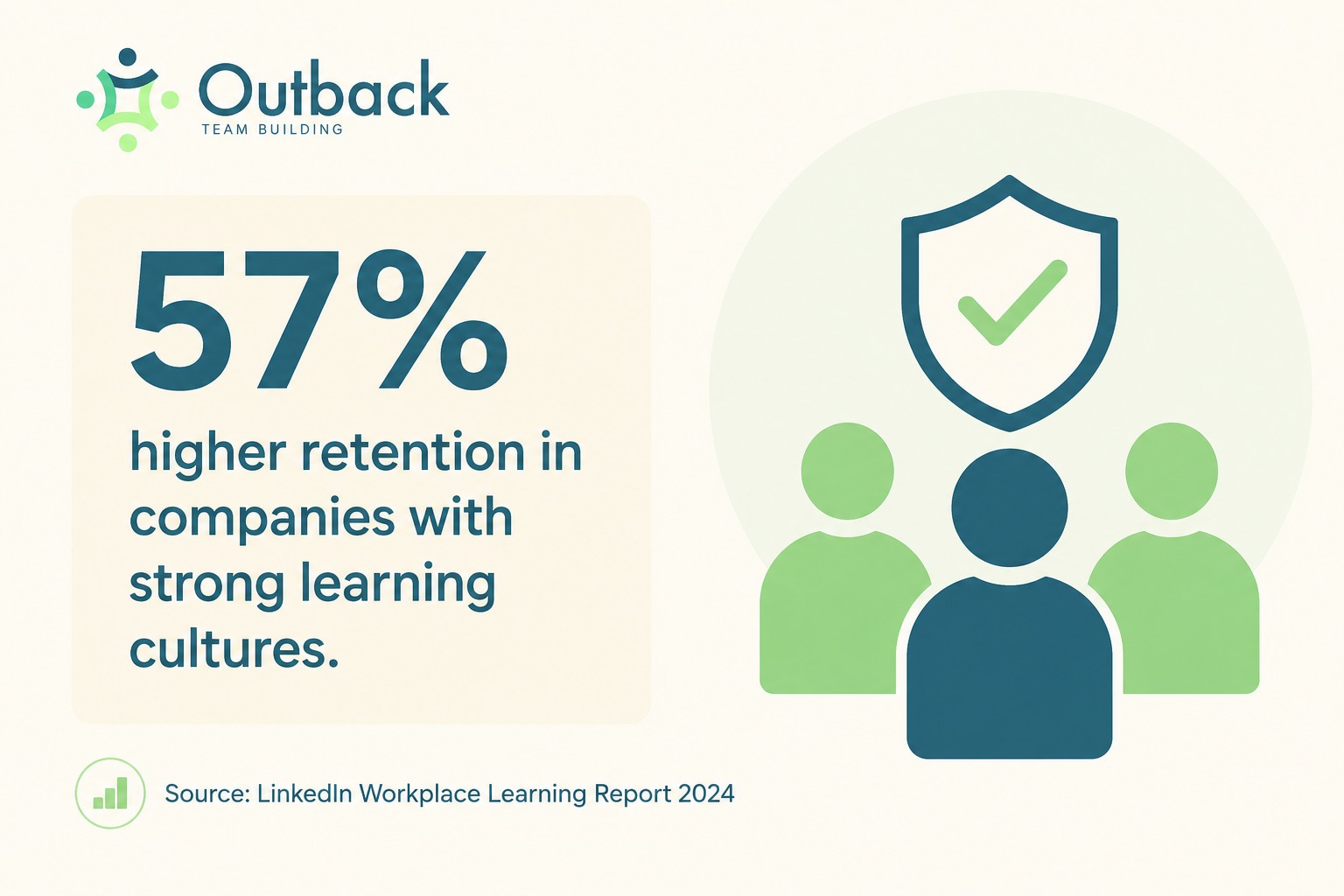
As LinkedIn’s 2024 Workplace Learning Report found, companies with strong learning cultures see 57% higher retention.
(Image by Ioana)
Strong Learning Culture Increases Employee Retention
Career development conversations can contribute to that kind of culture by replacing uncertainty with clearer direction.
They also give managers a clearer picture of what employees value, which makes future coaching, project assignments, and development decisions more relevant.
How to Prepare Managers Before the Conversation
Productive career conversations start before the meeting. A little preparation helps both people arrive ready.
What the Manager Sends Ahead
Send a few questions a couple of days before the meeting, so employees have time to think deeply about how they want to progress.
For example:
- What’s something you’ve wanted to learn but haven’t had the chance to yet?
- Which parts of your job give you energy, and which ones drain it?
- When have you felt most proud of your work this year?
What the Manager Needs to Know Walking In
Walking in cold makes these conversations much harder than they need to be.
Managers should spend ten minutes refreshing themselves on:
- Any internal opportunities that might be a good fit
- Skills the employee wants to build
- Recent project experience
- Previous 1:1 notes
It’s also worth reminding managers that career development looks different across different roles.
For example, if you’re coaching a CPA, make sure managers understand requirements like the Texas CPA ethics requirement. Career advice is much more useful when it reflects the reality of the role.
How to Train Managers to Run the Conversation
Give managers a simple conversation structure they can use every time until it becomes second nature.
Open Without Defaulting to Feedback
Teach managers to set the tone in the first minute so employees know this is about their future, not their past work.
Try a simple opening like, “Today isn’t about reviewing your performance. I’d love to talk about where you’d like your career to go and how I can help you get there.”
Questions That Surface What the Employee Actually Wants
The best answers usually come from talking about real moments and experiences rather than hypothetical job titles. Employees may say they want to become a manager, move into another department, or take on more responsibility, but those answers are often only a starting point.
Train managers to explore what sits behind the stated goal. Someone interested in management may be looking for greater influence, more ownership, or an opportunity to mentor others. Another employee may mention a specific role when what they really want is more creative work or greater contact with clients.
Follow-up questions help managers turn these broad ambitions into practical development options. The goal is not to finalize a career path during one meeting. It is to identify a direction the employee can begin exploring through their current work.
(Image by Ioana)
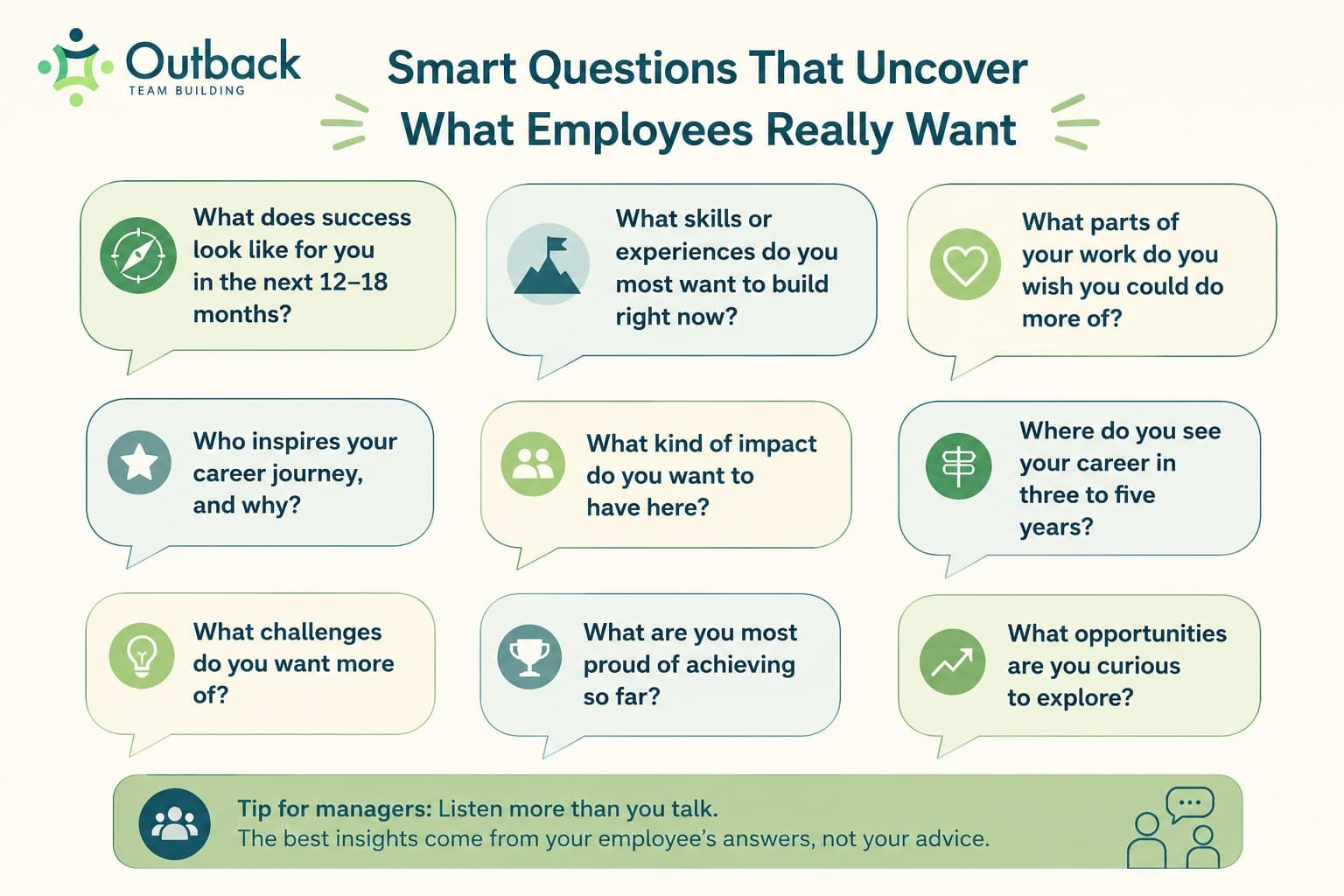
Career Conversation Questions to Spark Growth
Encourage managers to ask questions like:
- If another team came asking for your help, what would you hope it was with?
- Tell me about a day at work that flew by. What were you doing?
- If I took one task off your plate tomorrow, what would it be?
Use the employee’s answers to identify one small opportunity they can test in their current role. Someone interested in leadership, for example, could lead a project meeting, mentor a new team member, or coordinate a cross-functional task.
These experiences help the employee clarify what they enjoy while giving the manager useful evidence for the development plan.
Handling the “I Don’t Know’s”
“I don’t know” usually means someone hasn’t been asked before.
Train managers not to rush in with suggestions. Give people time to think.
If nothing comes, park the question rather than forcing an immediate answer.
Ask the employee to notice which tasks energize them, which problems they enjoy solving, and which responsibilities they would like to try over the next two weeks. Revisit those observations during the next 1:1 and use them to identify a realistic development direction.
Turning the Conversation Into a Documented Plan
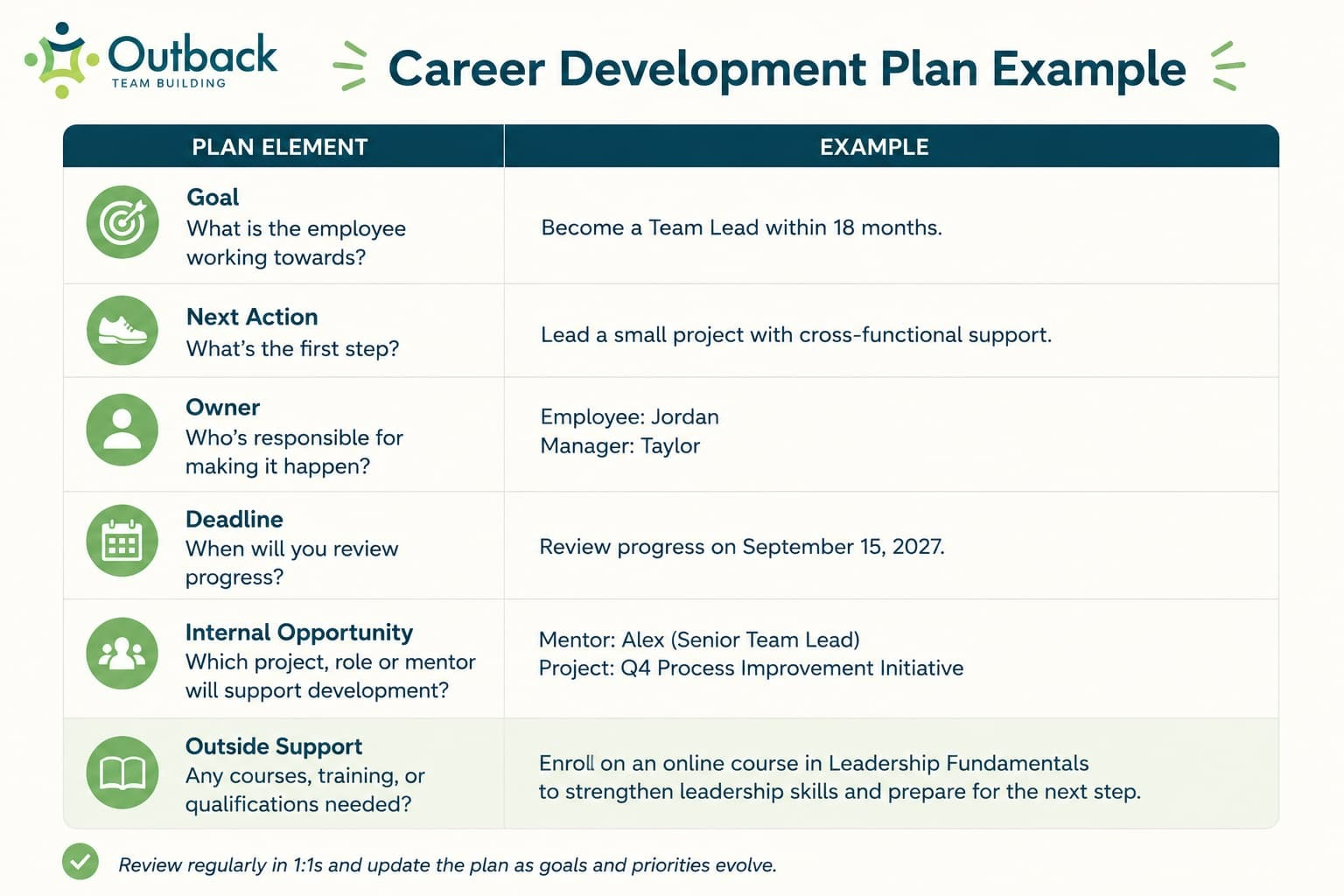
Turn the conversation into a simple plan with clear actions, owners, and deadlines.
Record:
- Goal: What is the employee working towards?
- Next action: What’s the first step?
- Owner: Who’s responsible for making it happen?
- Deadline: When will you review progress?
- Internal opportunity: Which project, role or mentor will support their development?
(Image by Ioana)
Example Career Development Action Plan
You should also document any outside support you’ve agreed on. Sometimes moving forward means gaining a qualification or completing a prerequisite. This might mean using an online, self-paced program such as Portage Learning so employees study around work and other responsibilities.
Other forms of development support, such as AI-powered learning experiences, can also help employees build new skills alongside traditional training.
Once the plan is documented, it should become part of the manager’s regular 1:1 rhythm rather than disappearing until the next formal career conversation.
A brief monthly check-in is usually enough. Managers can ask what progress the employee has made, what has changed, and whether the original action still makes sense. The discussion does not need to take over the entire meeting. Even five minutes can keep the plan visible and prevent deadlines from passing unnoticed.
Managers should also update the plan when priorities shift. An internal project may be delayed, a suitable mentor may become unavailable, or the employee may discover that the original goal no longer interests them. Changing the plan is not a failure. It shows that the conversation is responding to real experience rather than locking the employee into an outdated decision.
Common Mistakes and How Training Addresses Them
Most mistakes managers make are easy to fix with a little coaching.
| Instead of… | Train managers to… |
| Talking for most of the meeting | Ask a question, then wait for the answer |
| Turning it into a performance review | Keep bringing the conversation back to the future |
| Trying to solve everything | Agree on one realistic next step |
| Making vague promises | Finish with actions, owners, and dates |
Measuring Whether the Training Is Working
Start by looking at three things:
- Employee surveys. Do more people agree with statements like “I have opportunities to grow here” or “My manager supports my development”?
- Internal mobility. Are more employees applying for and moving into new roles?
- Retention by manager. Are people staying longer in some teams than others?
Track these measures before and after manager training, then review them alongside employee comments and follow-up completion rates. Positive movement does not prove that career conversations caused the change, but consistent improvement across several measures can show whether managers are providing clearer and more useful development support.
Wrap-up
Every career conversation is a chance to show someone there’s a future for them at your company. ✨
Give your managers the confidence to make those conversations count. Explore Outback Team Building’s leadership and professional development programs to help them get there.
FAQs
What makes a good career development conversation?
Clear questions, active listening, and a simple action plan make the biggest difference.
What’s the difference between a performance review and a career development conversation?
Performance reviews look at past results, while career conversations focus on future growth.
What should managers do after a career development conversation?
Agree on clear next steps, assign ownership, and schedule a follow-up to review progress.
Author Bio
Mike Bandar is an award-winning UK-based entrepreneur. A Founding Partner of Turn Partners, the startup studio focused on the acquisition, turnaround, or creation of digital businesses. Through Turn Partners, Mike co-founded Hopper HQ, the Instagram planning and scheduling tool, working with thousands of influencers, brands and agencies around the world.