Cognitive diversity is the mix of how people think. How they process information. How they make decisions. How they solve problems.
It’s not about job titles and/or demographics. But it’s about the different mental lenses people bring to the table. When you design team-building with those differences in mind, you get a more dynamic team with sharper ideas and better results.
Why? That’s because hard problems rarely yield to one mode of thinking. A team that blends analytical skeptics, creative explorers, practical doers, and emotionally attuned processors can see around corners.
Fret not; This page tackles what you need to know about cognitive diversity. Including common challenges to address. More importantly, learn how to design team-building activities designed for a mentally diverse team.
Read on.
Table of Contents
- What Is Cognitive Diversity?
- How To Design Team-Building Activities for Cognitive Diversity
- The Future of Team Building with Cognitive Diversity
What Is Cognitive Diversity?
As the name implies, cognitive diversity is the variety of ways people prefer to think and contribute.
Some teammates break problems down and follow the data. Others dream up options and play with “what if” scenarios. Some make things concrete and test-ready. Others tune in to people and context.
You can label these thinking styles in lots of ways. But a simple, useful set includes:
- Analytical
- Creative
- Practical
- Emotional and social
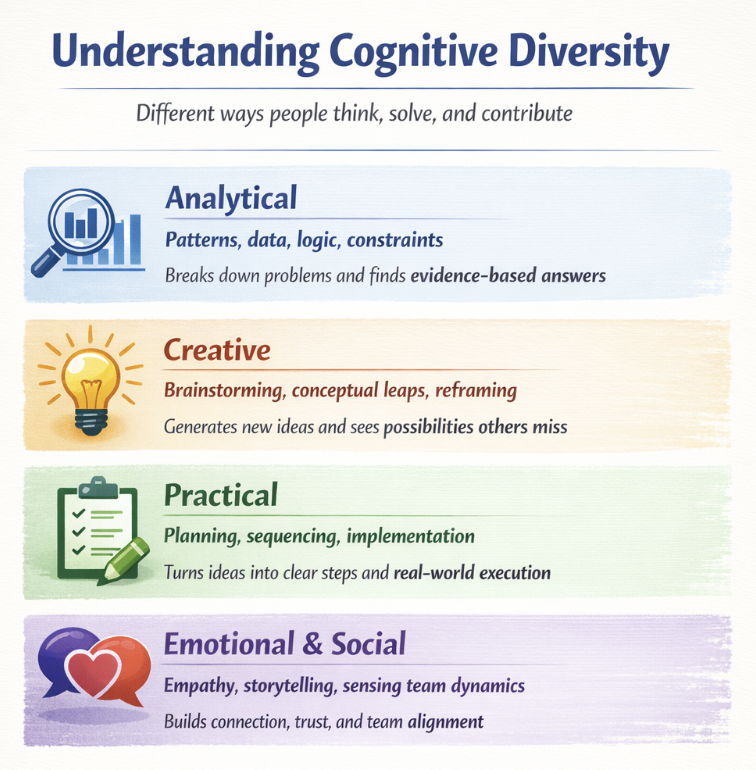
Image source: Generated by the author via ChatGPT
This variety changes outcomes. Research has shown that groups of diverse problem solvers can outperform groups of high-ability problem solvers who all think alike. Why? Because they bring different tools to the puzzle and avoid the same blind spots.
Other studies suggest that diverse teams surface facts more often and stay objective longer. Which can lead to smarter decisions. And when team norms support equal participation and social sensitivity, teams show higher collective intelligence overall.
Jeffrey Zhou, CEO and Founder of Fig Loans, has seen this play out in high-stakes financial decision-making.
Zhou says, “In lending, you need analytical thinkers to assess risk. Creative thinkers to design flexible financial products. And practical operators to make sure those solutions actually work for customers. When those perspectives come together, you get smarter, more balanced decisions that serve both the business and the borrower.
The trick is designing team-building that makes those differences visible and useful.
What Are The Challenges of Cognitive Diversity?
If cognitive diversity is so powerful, why isn’t every team humming along? Because:
- Differences can feel uncomfortable. Analytical teammates can see creative ideation as “too fluffy.” Creative thinkers can experience detailed questioning as nitpicking. Practical implementers may think both camps are missing deadlines. And those skilled in sensing group dynamics sometimes worry their voice will be dismissed as “soft.”
- Biases creep in, too. Many teams equate being quick to speak with being decisive. Or they prioritize the loudest idea over the best one. Without clear norms, the same few people drive every conversation, while quieter or reflective processors opt out.
For Bryan Henry, President of PeterMD, this tension is something leadership has to actively manage. In healthcare and wellness operations, different thinking styles don’t always align naturally.
Henry explains, “You can have the right mix of thinkers in the room, but if the environment doesn’t support open input, those differences turn into friction instead of insight. Leaders have to create space for both data-driven debate and idea exploration, or you end up with safe, one-dimensional decisions.”
Straightforward ways to reduce friction:
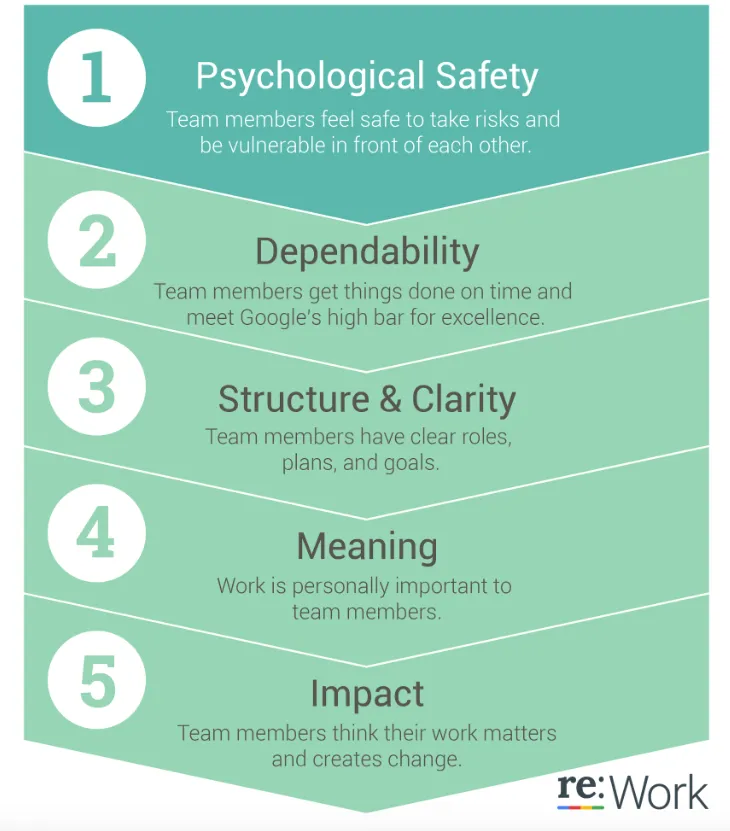
- Create psychological safety. That way, people feel safe to question, disagree, and admit uncertainty. Google’s Project Aristotle found psychological safety to be the top driver of team effectiveness, echoing decades of research by Amy Edmondson.
- Normalize different contributions. Say out loud that data challenges, bold ideas, crisp plans, and people-centered insights all have a place.
- Set turn-taking structures. That way, airtime is shared. It sounds simple. It works.
How To Design Team-Building Activities for Cognitive Diversity
Team-building shouldn’t flatten differences. It should spotlight them in a way that feels energizing and useful. A few principles make a big difference.
Designing team-building activities
- Build in multiple entry points. Structure exercises with multiple entry points. Data analysis for analytical thinkers, brainstorming for creatives, and hands-on problem-solving for practical minds. This way, everyone contributes from their strengths while learning to appreciate different perspectives.
- Alternate divergent and convergent phases. First expand options, then narrow with criteria. Think of it like breathing in and out.
- Make roles and processes explicit. People relax when they know what’s expected. Rotate roles so every style leads at least once.
- Use constraints as creative fuel. Boundaries help analytical and practical minds focus and keep brainstorms grounded.
- Measure team-building ROI. Pay attention to what changes after the activity. Are more people speaking up? Are decisions clearer and faster? Use those small signals to see what’s working and what to improve next time.
Activity ideas you can adapt today
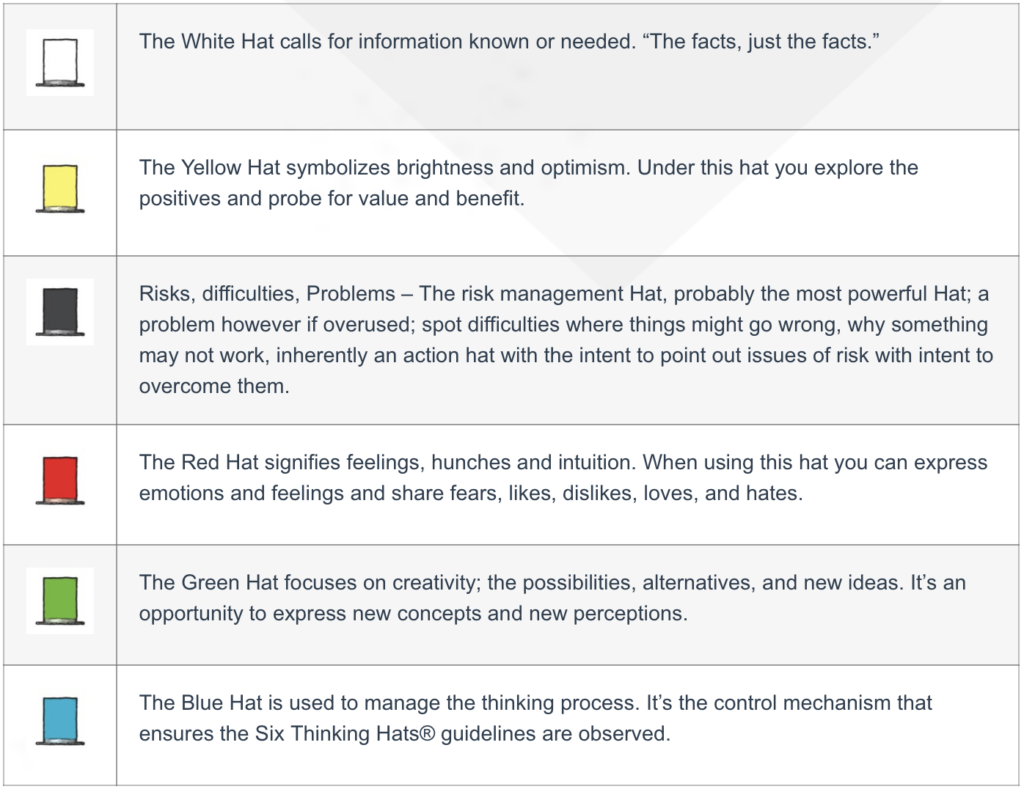
- Rotating Hats Workshop: Borrow the spirit of Six Thinking Hats to guide teams through distinct modes: facts, ideas, risks, benefits, process, and empathy. Keep it light and timed so it moves.
- Data-to-Decision Sprint: Share a short dataset or brief. Phase 1: individuals note patterns and questions. Phase 2: small groups brainstorm options. Phase 3: align on decision criteria. Phase 4: build a quick plan and a 90-day test.
- Prototype Relay: Teams sketch, then build a low-fi prototype with simple materials, then user-test with another group. This naturally engages creatives, doers, and empathic listeners.
- Silent Start, Loud Finish: Begin with silent idea generation on sticky notes (or a virtual board), then cluster and debate. Introverts contribute early, extroverts add energy later.
- Constraint Remix: Pick a familiar process and impose a playful constraint (no email, $0 budget, 48 hours). Watch fresh thinking emerge within real-world limits.
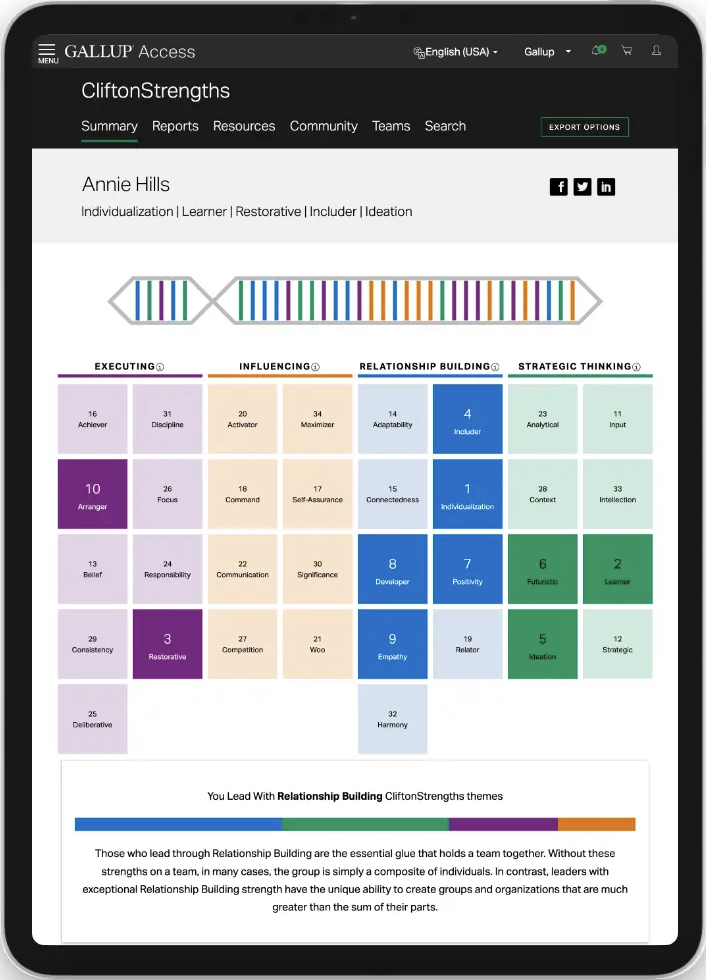
To tailor activities, consider using light-touch assessments to spot preference patterns. Tools such as CliftonStrengths and HBDI can spark meaningful conversations when used as inputs. Ask people how they like to contribute. Then, design your agenda like a balanced meal, so every style gets its fair share of food for thought.
In technical and production-driven environments, designing for cognitive diversity isn’t optional. It’s what keeps ideas both innovative and executable.
Gavin Yi, CEO & Founder of Yijin Solution, sees this firsthand when engineering teams collaborate across production and client requirements.
Yi shares, “In manufacturing, creative ideas are only valuable if they can be built efficiently and meet real-world constraints. We rely on analytical thinking for precision and creative thinking for design improvements. However, we also need practical thinking to bring everything together on the production floor.
He concludes, “When team activities reflect that balance, collaboration becomes much more effective.”
Practical tips for facilitators
It’s crucial to support diversity and inclusion in the workplace. And this essentially applies to cognitive ability as well.
If you lead teams with diverse cognitive abilities, a few habits make it easier for everyone to participate. As a facilitator, here’s what to do:
- Prime the group. Share a brief, data points, and questions a day ahead. Analytical and reflective thinkers will come in warmed up.
- Start broad, then focus. Use a short, timeboxed brainstorm, then apply criteria. Write the criteria first to keep decisions transparent.
- Mix modalities. Alternate between talking, writing, sketching, and building. Different brains, different doors in.
- Structure airtime. Try 1-2-4-All to move from solo ideas to pairs, to small groups, to the whole room.
- Rotate roles. Who’s the data sherpa? The option generator? The risk spotter? The integrator? Rotate so each style leads once per session.
- Mind the energy. Short breaks beat long marathons. Keep snacks handy. Brains need fuel.
- Close the loop. End with decisions, owners, and next steps so practical thinkers don’t leave wondering what happens now.
That’s why facilitation is about designing how different thinking styles show up in the room.
For Wade O’Shea, Founder of BusCharter.com.au, this comes down to structure and timing. In logistics-heavy environments, unstructured conversations can quickly lead to confusion or missed input. That’s why decisions need to be both fast and coordinated.
O’Shea notes, “You can’t rely on one way of working. Some team members need time to process data, while others think best out loud. And some just want to act. Good facilitation creates space for each of those styles at the right moment…so the team moves forward without losing important perspectives.”
The Future of Team Building with Cognitive Diversity
Work is getting messier and more interesting. Problems cross boundaries. Customer expectations shift faster than our slide decks. Teams that tap into multiple ways of thinking will adapt more quickly and learn faster.
The move now is to design team-building that doesn’t just “bond” people. But to build the muscles of inclusive, multi-lens problem solving.
Start small. Add a silent start to your next brainstorm. Rotate roles in your next retrospective. Plan your next offsite with multiple entry points. You’ll feel the difference when more people light up, and your solutions get sturdier.
Looking for team-building ideas designed for a group with cognitive diversity? Check out Outback Team Building activities and events. To get started, request a quote today!
Author Bio
Catherine Schwartz is an author who specializes in employee well-being and engagement.