Workplace training is supposed to change how people work. We invest in it because we want teams to communicate better. We want them to make smarter decisions. And we want them to adapt faster.
But a lot of that carefully planned training fades fast. You’ve probably seen it: the workshop was great. The energy was high. Two weeks later, it’s back to business as usual.
The problem? It isn’t that people don’t care. Memory is slippery without the right support.
Why is most training forgotten so quickly? What actually helps knowledge stick long enough to change behavior on the job? Read on to find out.
Table of Contents
- What Is the Forgetting Curve?
- Common Weaknesses in Traditional Training Methods
- Key Factors That Enhance Training Retention
- Innovative Training Strategies That Work
- How To Measure Retention and Success in Training Programs
- Final Note: moving toward lasting knowledge retention
- FAQs
What Is the Forgetting Curve?
The Forgetting curve shows how memory drops steeply immediately after learning and then continues to decline without reinforcement. This is how our brains work. Not a flaw in your employees’ motivation.
More than a century ago, psychologist Hermann Ebbinghaus mapped what many of us experience today:
We forget a lot…and we forget it fast if we don’t revisit it.
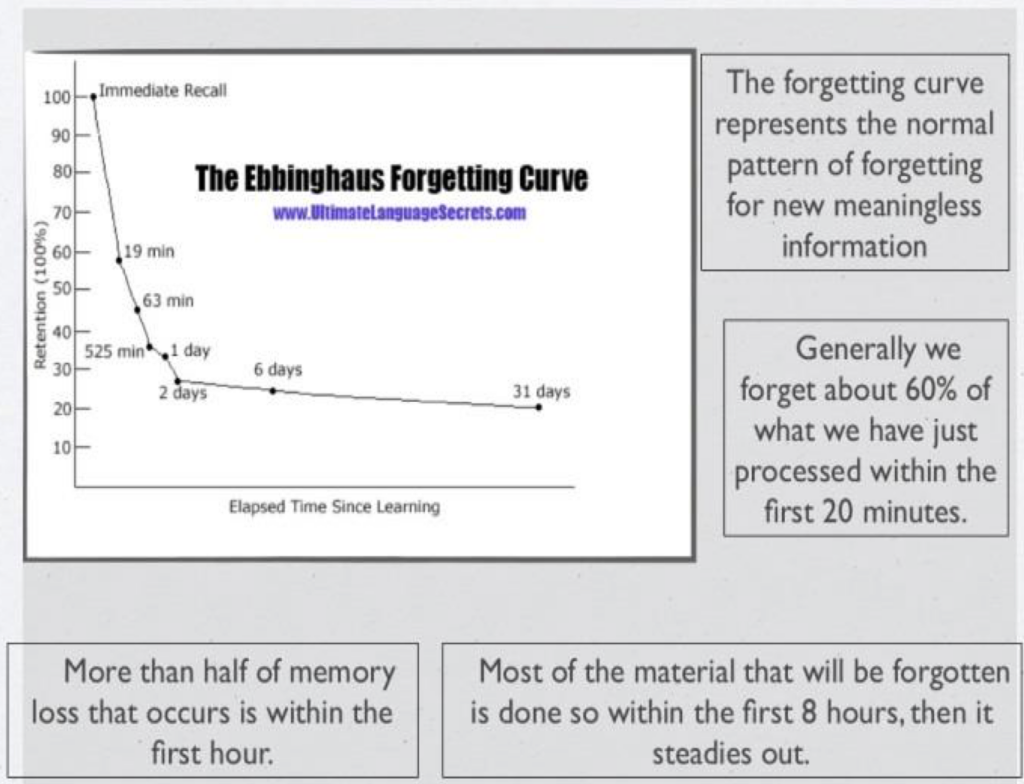
If you’ve ever left a great class and struggled to recall key points a few days later, you know what this looks like. One-off training events fight an uphill battle. Without follow-up, people can lose most of what they learned within days.
But the same research field also gives us proven ways to fight the slide.
Common Weaknesses in Traditional Training Methods
A lot of corporate training still relies on approaches that make forgetting almost inevitable.
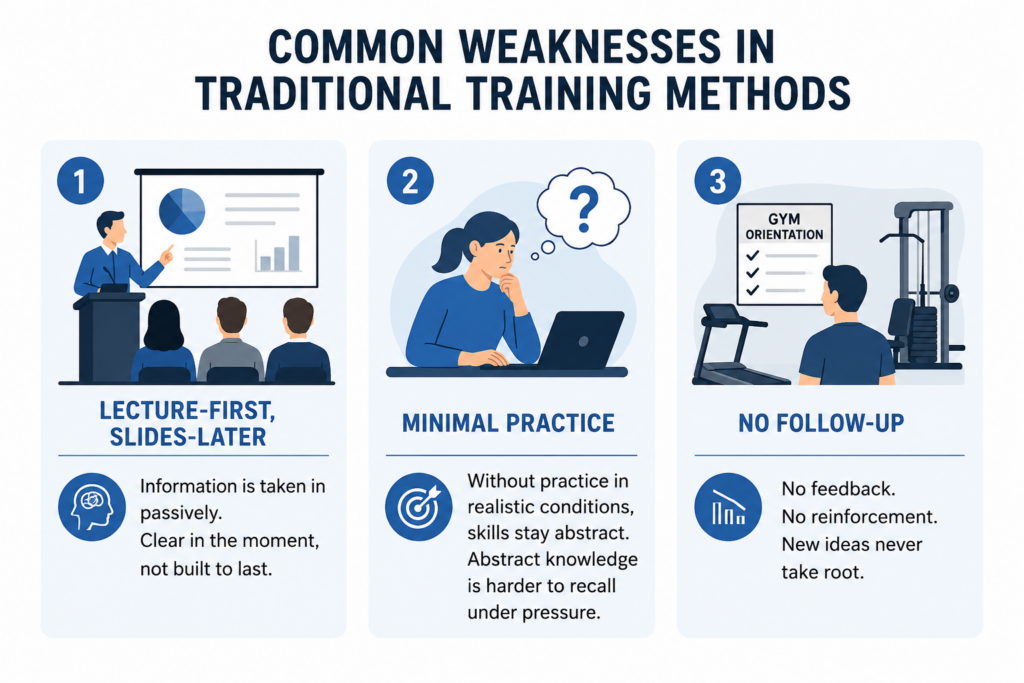
Image source: Photo generated by the author via ChatGPT
- Lecture-first, slides-later: When employees sit through long presentations, they take in information passively. It can be clear at the moment. BUT remember: clarity isn’t the same as durability.
- Minimal practice: If people don’t get to try the skill in realistic conditions, it stays abstract. Abstract knowledge is harder to recall under pressure.
- No follow-up: Think of it like a gym orientation without any return visits. You might know where the machines are. But you won’t build muscle. Many programs skip feedback and reinforcement, so the new ideas never get a foothold.
Heed our advice: these aren’t bad intentions. They’re just incomplete designs for how humans actually learn and remember.
Key Factors That Enhance Training Retention
Learning science gives us a better blueprint. With those gaps in mind, here are the factors that help training stick:
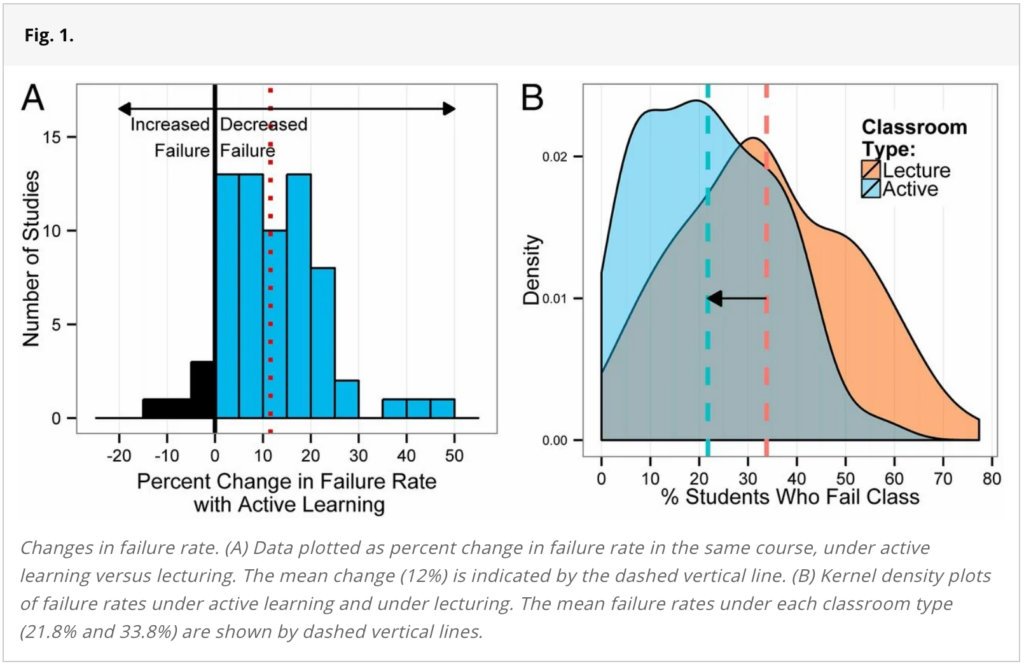
- Active learning: People remember more when they do more. A large meta-analysis in higher education found that active learning boosts performance and reduces failure rates versus traditional lecturing. The mechanics apply just as well to workplace skills. Why? Because they hinge on participation and practice.
- Retrieval practice: Quizzing isn’t just for school. Actively recalling information strengthens memory more than rereading notes. Researchers Roediger and Karpicke showed that self-testing improves long-term retention. Even if it feels harder in the moment.
- Spaced repetition: Spreading review over time beats cramming. This is one of the most reliable findings in cognitive psychology. Tailor-made for post-training reinforcement on the job.
- Real application: We remember what we use. Connecting lessons to everyday tasks, tools, processes, and decisions turns theory into habits.
Combine those elements…and you’re already ahead of most programs.
Innovative Training Strategies That Work
The ‘forgetting curve’ is real. It’s easy to see employees forget what they’ve learned right after undergoing training.
So, how do you go about making your employee training programs work in the modern workplace while ensuring retention?
Let’s cut the chase–here are innovative tactics to consider for your workplace training:
- Microlearning: Short but focused lessons (think five to ten minutes) fit real schedules. They pair well with spaced repetition. Even bite-sized content is easier to revisit. They can be timed to moments of need…right before a client call, for instance.
- Gamification with purpose: Sure, points and badges won’t fix a weak course. However, well-designed challenges and progress mechanics can boost engagement and practice opportunities. There’s a psychological benefit of gaming in the workplace.
- Social learning and cohorts: Peers make learning sticky. Peer shadowing and coaching build accountability and keep ideas alive past week one.
- Job-embedded projects: Assignments asking employees to apply a new framework to a live problem transform training from content to capability. The reflection afterward is where much of the retention occurs.
This is also where experiential learning shines. Omer Reiner, Founder of Texas Home Buyers, says people develop skills faster when they’re given opportunities to apply them in real situations.
In his business, new team members learn far more by evaluating properties in person and speaking with homeowners than by sitting through presentations alone.
Reiner explains, “The fastest learning happens when people solve real problems. We can teach our process in a meeting. However, it doesn’t truly stick until someone applies it in a live conversation or evaluates an actual deal. That hands-on experience builds confidence and makes the lessons much easier to remember.”
If you’ve ever learned to ride a bike, you know the feeling. You didn’t memorize a slide. You wobbled and adjusted. You felt the balance click. The same logic applies to leadership conversations and conflict resolution. Even problem-solving under time pressure.
How To Measure Retention and Success in Training Programs
If you can’t see what’s stuck, you can’t improve it. After choosing the right methods, the next step is measuring whether they worked. Measuring doesn’t have to be heavy or complicated. However, it should be continuous.
- Knowledge checks spaced over weeks
- Short on-the-job assignments with manager sign-off
- Behavioral observation checklists tied to specific skills
- Performance metrics aligned with the skill (cycle time, customer satisfaction, reduction in rework)
- Learner feedback about usefulness and confidence (not just satisfaction)
- Follow-up coaching notes or peer reviews
For instance, a provider offering TRT online could measure retention by giving clinicians short knowledge checks a few weeks after training. They could also review patient consultations and track whether best practices are consistently followed. If gaps appear, targeted coaching or refresher modules can reinforce the skills before they affect patient care.
The classic Kirkpatrick Model (think reaction, learning, behavior, and results) is still a helpful lens when used thoughtfully. The aim isn’t to chase perfect data. Create quick feedback loops so you can tweak content and support until you see behavior change.
Final Note: moving toward lasting knowledge retention
Most workplace training fades because it asks people to remember a lot, once, then move on. Memory doesn’t work that way. The fix is straightforward, even if it takes discipline: make learning active, bring it into real work, revisit it over time, and keep score on what changes.
Build training around those principles, and you’ll see more of what you hoped for at the start: skills that show up on the job. Not just in the room.
Outback Team Building specializes in experiential programs designed to turn learning into action. Browse programs or reach out via the contact page to talk through your goals and constraints. A small shift toward doing and measuring can make a big difference.
FAQs
1. Why do employees forget workplace training so quickly?
People naturally forget much of what they learn within days/weeks without constant reinforcement and practice.
2. What training method improves retention the most?
It’s a combination of active learning, retrieval practice, spaced repetition, and hands-on application. This combo tends to produce the best long-term retention.
3. How can companies measure whether training is working?
Track knowledge retention over time. Observe behavior changes on the job. Monitor performance metrics. Gather manager and learner feedback.
Author Bio
Catherine Schwartz is a marketing & e-commerce specialist helping brands grow their revenue and take their businesses to new levels. Her work sits at the intersection of brand, content, and commerce. She translates big-picture strategy into the day-to-day decisions that actually compound: which audiences to reach, what story to tell, and how to make every channel pull its weight. She write about marketing, PR, technology, and team performance.